
Vera Audio P150/600 RS
Power amplifier with world class performance. Black or silver finish.


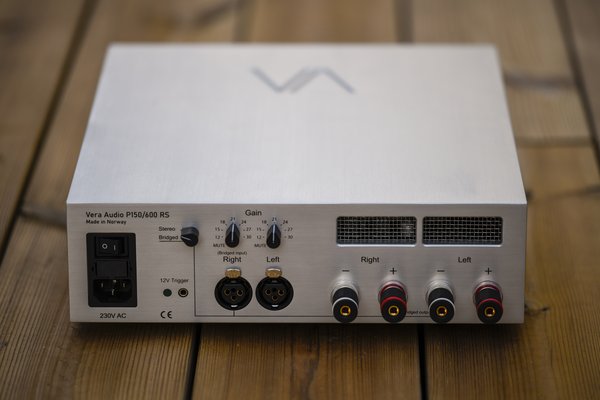

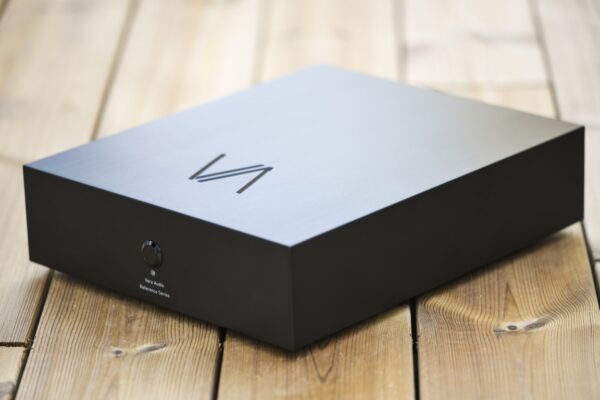
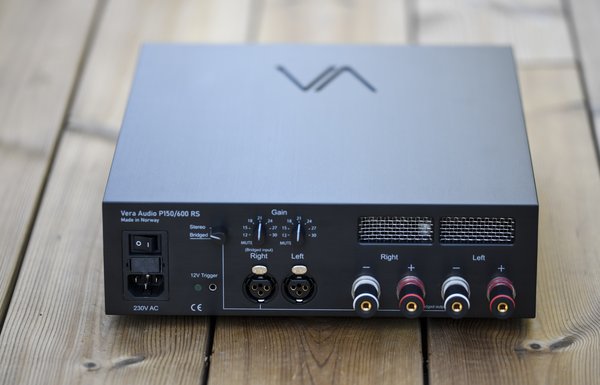


This model is no longer in production.
Manuals and technical documentation remain available under the Downloads tab. For service, spare parts or questions about an existing unit, contact us at info@vera-audio.com.
The current model in this range is the P400/1000 V2.
Product info
- Based on Purifi Eigentakt modules. Compatible with 230V and 120V.
- Stable to 2 Ohm (with less power)
- Powerful PSU of 3kW which reduces ripple and keeps the amplifier cooler
- Over 150W at 8 ohms (2 channels)
- Bridging option with more than 600W at 8 ohms (1 channel) and 900W in 4 Ohm with less than 0.0007% THD+N, making sure of distortion free sound at all levels
- Exceptional low distortion, perfect linearity and the new class D modules minimizes intermodulation distortion compared to other designs
- A feedback solution that gives exceptionally high damping factor of 13000 and 1400 all the way up to 20kHz (8 Ohm)
- Vera Audio input stage (buffer) with only the very best measurable parts
- No degrading potentiometers in the signal chain. A gain adjustment with 8-step rotary switches with gold contacts
- 0.004% precision resistor which helps to provide a CMRR (common mode rejection ratio) of at least 94dB at 1kHz
- Multi-step EMI filtering in the input stage to effectively keep harmful radio waves away from the audio circuit. In addition, the entire input stage is mounted inside a screen in a separate chamber inside the cabinet. There are also extra shielded Neutrik XLR connectors

Very low noise and high CMRR makes it even a perfect combination with horns or other high sensitive speakers.
Functions and cabinet:
- Gain adjustment within 0.01 dB on both channels making it easy to match with different preamps/DACs or to incorporate to active speakers with amps to each driver
- A microcontroller monitors all the parameters of the Eigentakt modules and will warn with the LED in front of any overloads and temperatures. In the event of any faults that can damage the speakers, the amplifier will turn off in less than 200ms
- Auto standby function that automatically switches the amplifier to power saving mode after 3 hours of no signal. In standby mode the power consumption is only 0.25W and this function increases the life span of the amplifier. It can be turned off by using the trigger input
- Trigger input with LED light indicator
- Brushed aluminium chassis cut out from one block without any seams or visible screws
- Speaker terminals that accept up to 6mm² stranded wire, spades and banana plugs
See datasheet under downloads for measurements.
Some key performance data:
- Selectable gain in very accurate 3dB steps from 12dB to 30dB as well as mute function
- CMRR of at least 89dB@100Hz and better than 94dB@1kHz (measured based on the IEC 60268-3 standard)
- Very low noise of less than 18uV
- S/N of more than 125dB (stereo)
- S/N of more than 128dB (bridged)
Technical data is measured with 240V current on 10 random units. Minimum values are stated.
- Output impedance (20Hz–1kHz measured at terminals): < 0.6mΩ
- Output impedance (20kHz measured at terminals): < 6mΩ
- Damping factor 20Hz–1kHz: > 13000 with 8Ω speakers
- Damping factor 20kHz: > 1400 with 8Ω speakers
- Input impedance stereo: 94kΩ
- Input impedance bridge: 47kΩ
- Noise: < 18uV (A-weight)
- Frequency response DC–20kHz: ±0.05dB (-3dB 60kHz)
- Signal-to-Noise Ratio stereo: > 125dB
- Signal-to-Noise Ratio bridged: > 128dB
- Standby power: 0.25W
Continuous power:
Stereo, both channels driven at 8 Ohm:
– 220W with maximum 1% THD+N
– 180W with maximum 0.01% THD+N
– 140W with maximum 0.0005% THD+N
Stereo, both channels driven at 4 Ohm:
– 420W with maximum 1% THD+N
– 340W with maximum 0.01% THD+N
– 270W with maximum 0.0007% THD+N
Bridged 8 Ohm:
– 800W with maximum 1% THD+N
– 680W with maximum 0.01% THD+N
– 600W with maximum 0.0005% THD+N
Bridged 4 Ohm:
– 920W with maximum 1% THD+N
– 900W with maximum 0.0007% THD+N
Dimensions and weight:
Width: 29 cm
Depth (including terminals): 38 cm
Height: 8.2 cm
Weight: 7 kg
1. What output impedance of the source (pre amplifier or DAC) matches the Vera Audio P150/600 RS?
The input stage of the Vera Audio P150/600 RS is very easy to drive with an input impedance of 100kΩ. Everything with output impedance below 2kΩ will work well. If the output impedance of the source is higher than 2kΩ, there will be a roll off in the frequency response at 20kHz.
2. My source only has RCA outputs. What RCA to XLR cables should I use?
The RCA to male-XLR cable should be made according to this:

Unfortunately, many sellers of cables do not understand this, so it is important that you check this yourself and ask the cable manufacturer if you are uncertain. This cable uses the standard pinout with pins 1 and 3 of the XLR connector wired to the shield of the RCA plug and pin 2 of the XLR connector wired to the tip of the RCA plug.
3. What does the gain setting do and what is the optimal gain setting?
The gain setting is used to optimize the noise level, adjust to the output voltage of the sources, or used in an active speaker system to match the level between drivers/speakers. The gain setting does not affect maximum power. However, lower gain setting requires higher input voltage from the source to play equally loud. The industry standard of 27dB gain is too much in many systems. The result may be that noise from the sources are amplified too much, causing hiss in the speakers. Lowering the gain on the power amplifier will always result in less hiss in the speakers and lower the noise floor. With today's distortion free high output from many sources a gain setting of 18dB or 21dB is often a much better option.
The 12dB or 15dB option is for customers that have very sensitive speakers. To reach full power in the 12dB setting a 13V input signal is required.
In bridged mode the gain is 6dB more than indicated on the switches. So if both are set to 15dB, the effective gain will be 21dB. They can be set to different gain settings as well, so that if one is 15dB and the other is 18dB the bridged gain will be 22.5dB.
4. Can the gain control be used while the amplifier is operating?
Yes, it is completely safe to use the gain switch simultaneously when the amplifier is passing through a signal.